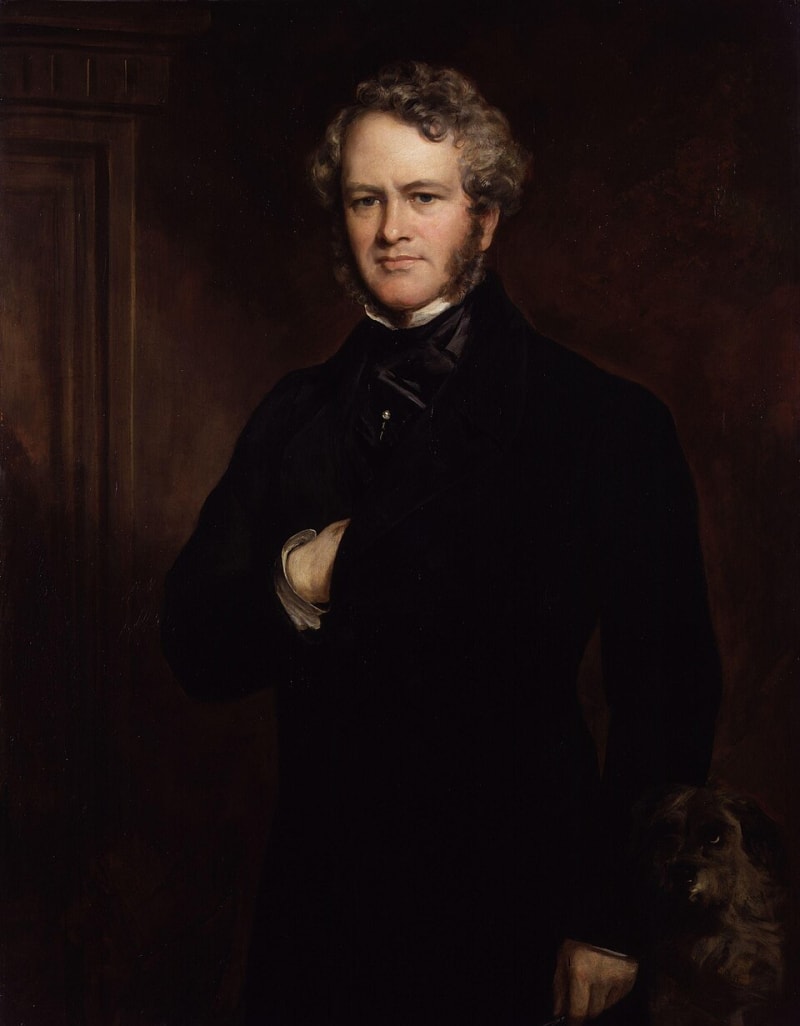
Edwin Landseer is the painter most people are quietly thinking of when they picture a "vintage dog portrait" — even when they don't know his name. A bloodhound resting beside a Scottish terrier in a stable doorway. A Newfoundland watching the surf with the gravity of a sea captain. A border collie at the foot of his master's coffin, refusing to leave. These were the images Landseer made for sixty years, and they fixed something in the British imagination that has never quite worked itself loose: the idea that a dog deserves to be looked at the way a duke deserves to be looked at — slowly, carefully, on canvas.
Queen Victoria adored him. He was knighted in 1850. By the time he died in 1873, half of Britain's drawing rooms had a Landseer print over the mantelpiece, and the rest wanted one. He painted dogs the way other painters painted statesmen — with the same gravity, the same care for likeness, the same insistence that the subject was worth the time. That, more than anything, is the tradition Pet Pic Portraits draws on at vintagedogoilpainting.com. It is, simply, the Landseer tradition.
Who Was Sir Edwin Landseer?
Born in London in 1802, Landseer was a child prodigy of the embarrassing kind. His father, the engraver John Landseer, set him to drawing animals at the age of five. By eight, he was sketching from life at the menagerie. By thirteen, he had work hanging in the Royal Academy — an age at which most painters are still grinding chalk for their teachers.
He apprenticed under Benjamin Robert Haydon, who insisted his students study anatomy directly from dissection. Landseer never lost the habit. The reason a Landseer dog feels solid on the canvas — the reason you can see the weight of a foreleg pressing into the floor, the loose skin gathering around a bloodhound's jaw — is that he had drawn that anatomy a hundred times before he ever painted it.
He was elected an Associate of the Royal Academy at twenty-four, the youngest age the rules allowed. By his thirties he was the most fashionable painter in England. Queen Victoria first sat to him in 1839 — she was twenty, newly crowned, dog-mad — and the friendship lasted the rest of his life. He painted her dogs constantly. He painted her children with their dogs. He gave her drawing lessons. When she knighted him in 1850, the gesture surprised no one.
His later years were harder. A nervous breakdown in 1840, recurring bouts of depression, a serious carriage accident, and the slow corrosion of alcoholism narrowed his world. He died in October 1873 at seventy-one. The Royal Academy lowered its flag. His brother John engraved most of his major works, which is the main reason Landseer's images saturated middle-class British homes for the rest of the century — there was a print for every parlor.
What Made the Landseer Style Different
Before Landseer, animal painting in Britain was largely a sporting genre. George Stubbs had given it anatomical seriousness in the previous century, but the dogs and horses in most paintings were trophies — proof of the owner's land, his stable, his hounds. The animal was a possession.
Landseer did something quieter and stranger. He painted dogs as if they had inner lives. Not in the Disney sense — there is no cartoon mugging in his work — but in the sense that you can see the animal thinking. A Landseer dog is alert, or wary, or grieving, or comfortably bored. The mouth is closed. The eyes do the work.
He was not above sentiment, and his critics — then and now — pointed out that he occasionally tipped over into it. Ruskin admired him and worried about him in roughly equal measure. But the best of Landseer's work walks a tightrope that no one before him had really walked: domestic warmth combined with classical gravity. A scruffy terrier given the lighting of a state portrait. A working bloodhound treated as if he were posing for Velázquez.
The technical signature is just as recognizable. Warm earth tones. A low, dramatic key, often with one strong light source falling from the upper left. Backgrounds simplified almost to abstraction so the animal sits forward on the canvas, fully present. Loose, confident brushwork in the fur — particularly in the muzzle and the chest, where the eye lingers — and tighter rendering around the eyes and the nose, where likeness lives. It is a style that looks effortless and is not.
His Most Famous Dog Paintings

Landseer produced hundreds of canvases. A handful became, and remain, the images by which the entire genre is remembered.
Dignity and Impudence (1839). Two dogs in a kennel doorway: Grafton, a magnificent bloodhound, sitting with the patient gravity of a magistrate, and beside him Scratch, a small white Scottish terrier looking out at the world with cheerful insolence. The painting hangs in Tate Britain. Almost two centuries later, it is still a perfect demonstration of how a painter can give two dogs entirely different personalities without painting a single human face.
The Old Shepherd's Chief Mourner (1837). A border collie rests his head on the closed coffin of his master, in a small, dim, impossibly quiet room. There is no human in the picture. There doesn't need to be. The dog's grief is enough. Ruskin called it "one of the most perfect poems or pictures (I use the words as synonymous) which modern times have seen." It is held in the Victoria and Albert Museum and remains one of the most powerful arguments ever painted for the moral seriousness of dogs.
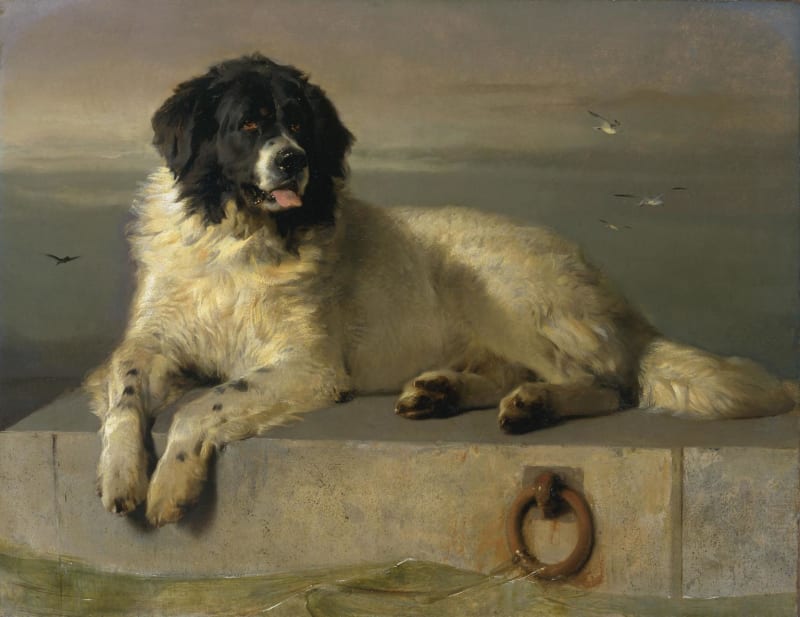
Saved (1856). A Newfoundland sprawled on a stone pier, soaked to the chest, the small body of a child held safely between his paws. The picture is melodramatic — Landseer's late work often was — but it is also responsible for the way a generation of Victorians thought about Newfoundlands.
Eos (1841). A portrait of Prince Albert's favorite greyhound, painted as a gift for the prince and still in the Royal Collection. Eos stands beside her master's hat, gloves, and walking stick — a quiet study of a dog as the still center of a man's domestic life. It is one of the most personal pictures of the entire Victorian court.
The Landseer Newfoundland
There is a breed of Newfoundland literally named after him.
In the 19th century, Landseer painted the black-and-white variety of Newfoundland so often, and so memorably, that the variant took on his name. To this day, the international kennel clubs of continental Europe recognize the Landseer as a separate breed; in the British and American clubs it is classified as a colour variant of the Newfoundland. Either way, the name is the same. Few painters in history have been honored so directly by their subjects, and fewer still by an entire dog breed.
Beyond Dogs — The Monarch of the Glen and the Trafalgar Square Lions
It would be a mistake to leave the Landseer story at dogs. His most internationally recognized image and his most physically permanent monument are both about other animals.
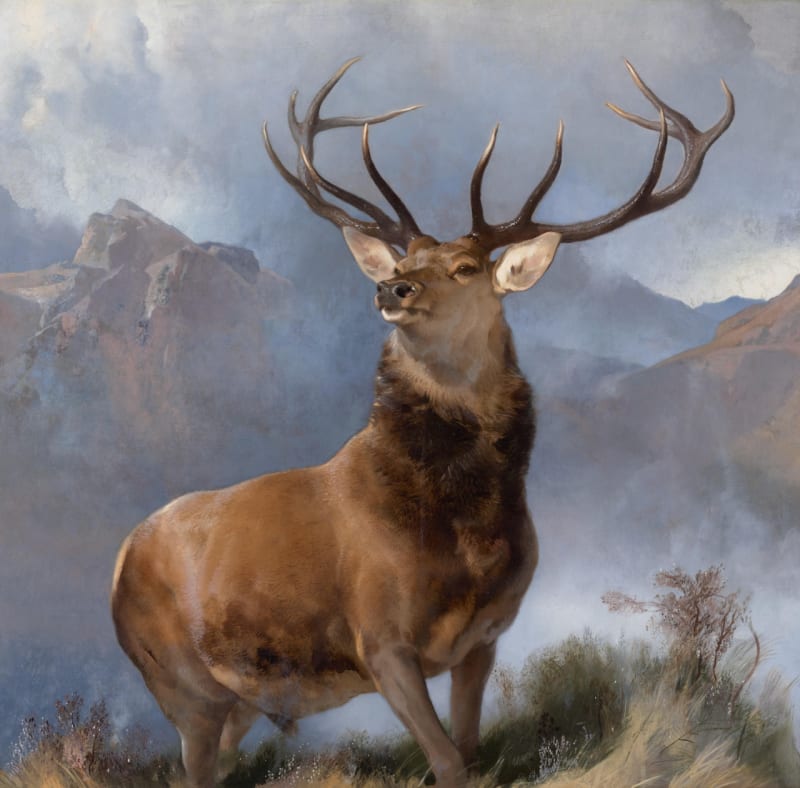
The Monarch of the Glen (1851) is a twelve-point Highland red stag standing on a ridge against the misty Scottish mountains. Landseer painted it for the refreshment room of the House of Lords; the commission fell through, the painting passed through several owners, and it eventually became one of the most reproduced images in British art history — on whisky bottles, on biscuit tins, on prints in pubs from Inverness to Sydney. The National Galleries of Scotland acquired it in 2017 for £4 million after a public fundraising campaign. It is, by any reasonable measure, one of the most famous animal portraits ever made.
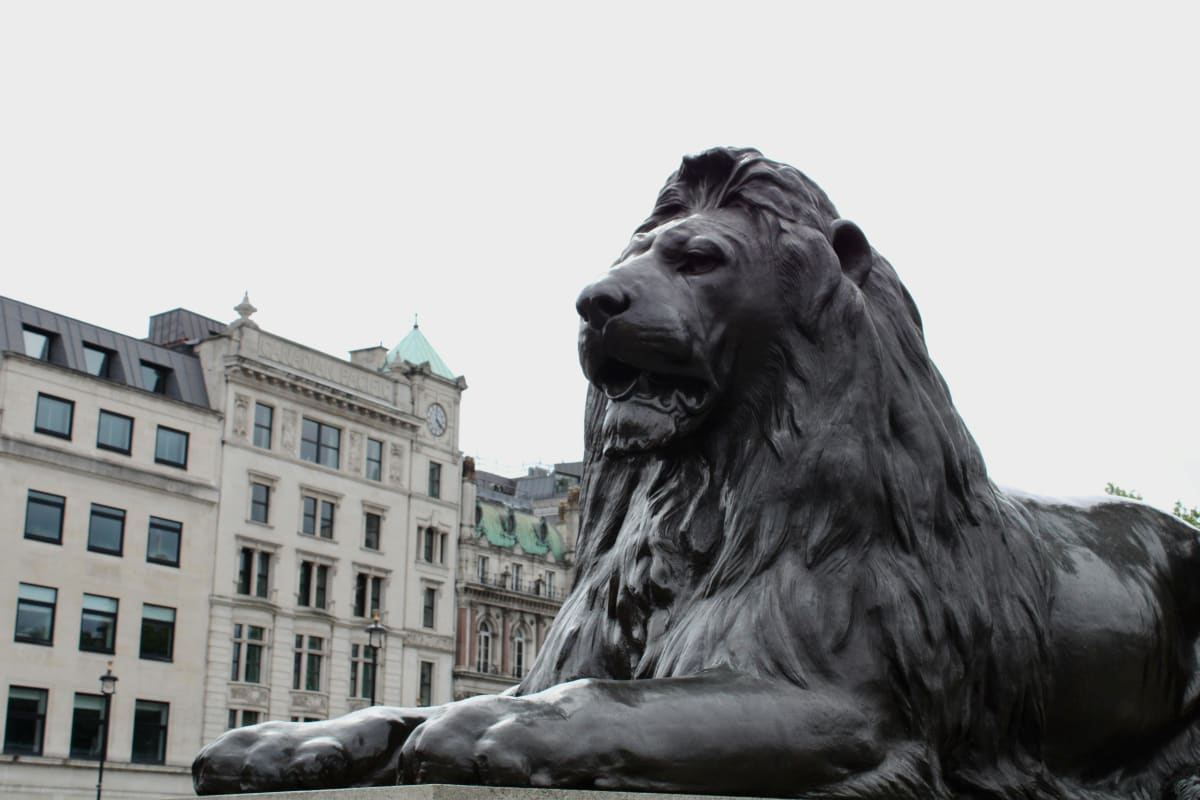
The four bronze lions at the base of Nelson's Column are also Landseer's. He was commissioned in 1858 to design them, drew them from a real lion carcass that decomposed before he finished (a famously difficult commission for a man who had never sculpted), and the lions were finally cast and installed in Trafalgar Square in 1867 — eight years late, but unmistakably his. They are visited by more than ten million people a year. Most of those visitors have no idea the lions came from the same hand as the painting of the Border Collie at his master's coffin. They did.
The breadth of his catalogue — domestic dogs, court greyhounds, Highland stags, public-monument lions — is part of why his name carries the weight it does. He was the animal painter of his century, in the broadest possible sense.
Where His Work Hangs Today
The major Landseers live where you would expect them to. The Royal Collection holds the largest single concentration — Eos, the various paintings of Victoria's dogs, the family portraits with Dash and Islay and Cairnach. Tate Britain holds Dignity and Impudence and several of the great character studies. The Victoria and Albert Museum holds The Old Shepherd's Chief Mourner. The Yale Center for British Art, in New Haven, holds an important group of his sporting and Highland pictures.
His studio works — the smaller dog portraits, the unfinished oil sketches, the engravings worked up in his own hand — still come up regularly at Sotheby's and Christie's. Strong examples trade at auction in the $5,000 to $50,000 range, with major canvases climbing into six figures when one surfaces. A 19th-century Landseer is not, in the grand scheme of things, an inaccessible object. It is, however, an object of someone else's dog.
The Landseer Tradition Today
This is the part worth being honest about.
When a modern dog owner — particularly an American one, in a house carefully assembled over twenty years — pictures the painting they would like of their own dog, they are picturing a Landseer. They may not know it. They may have never said his name out loud. But the warm palette, the dark drawing-room background, the dog rendered with the gravity of a portrait sitter rather than the cuteness of a calendar — that is the Landseer image, and it has been the default image of "a real oil painting of a dog" for almost two centuries.
The tradition is what gives the format its weight. A photograph says this happened. A vintage-style oil portrait, in the Landseer manner, says this mattered. That sentence is not new. It is the same sentence the Victorian middle class wrote out for themselves when they hung a Landseer engraving over the mantel — the same sentence Queen Victoria wrote out when she commissioned a portrait of Eos for Albert's birthday in 1841. The format is the message.
Pet Pic Portraits exists at the modern end of that tradition. We render your dog in the visual language Landseer codified — warm tones, dramatic light, classical composition, the dog rendered with the seriousness Landseer gave to a bloodhound in a kennel doorway. The aesthetic is the Landseer aesthetic. The production is modern: AI-rendered, then personally reviewed by Mercy before it ships. Not antique. Not hand-painted. We are upfront about the process every single time. What we promise is the aesthetic — the thing Landseer spent a lifetime perfecting — applied to the dog you actually live with.