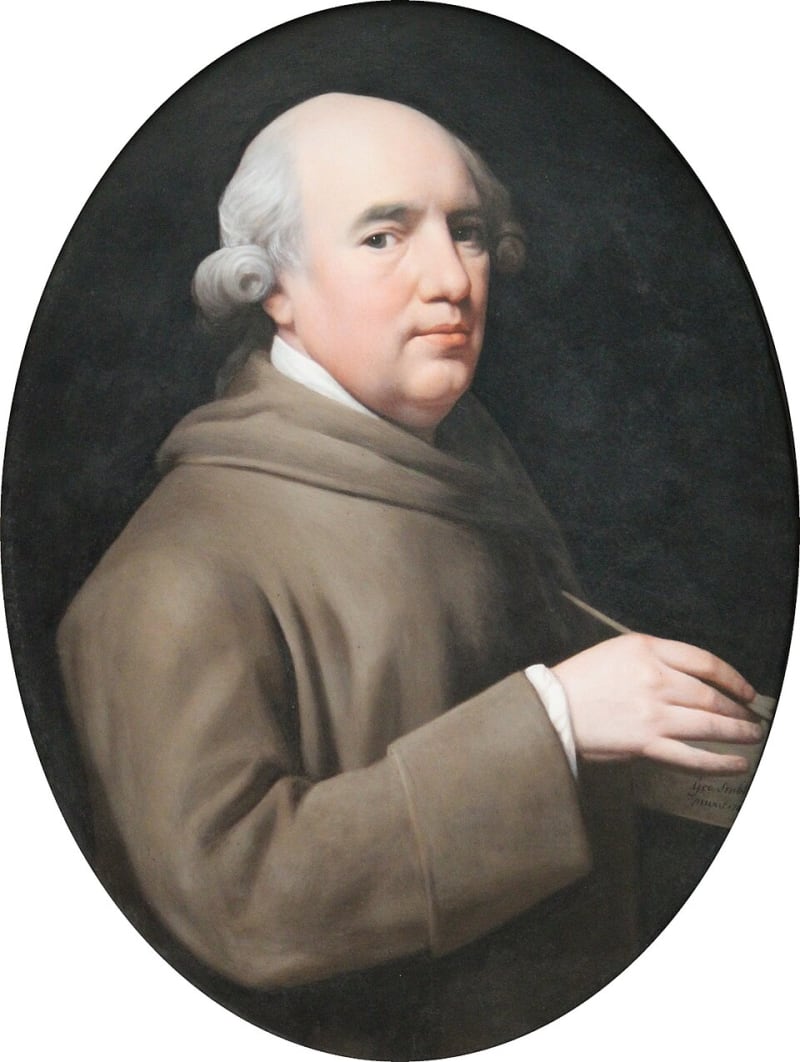
George Stubbs did something nobody else in eighteenth-century England was doing: he painted animals as if they mattered. Not as decoration, not as background props for a hunting scene, not as symbols of a patron's wealth — but as individuals, with anatomy you could trust and presence you couldn't ignore. His contemporaries painted what they saw. Stubbs painted what was actually there.
If you've ever stood in front of one of his dog portraits — a spaniel rendered against a moody English landscape, the fur catching low light, the eyes alert and specific — you've felt the difference. The dog is not a type. The dog is a someone. That instinct, the one that says this animal deserves to be looked at the way we look at people, is the entire reason a vintage oil painting of a dog still moves us three hundred years later. And it's the reason Stubbs is the painter every serious animal artist since has had to reckon with.
This is a short tour of who he was, what made his work different, and why the tradition he started still defines what we mean when we say a dog deserves to be painted properly.
A Self-Taught Anatomist from Liverpool
Stubbs was born in Liverpool in 1724, the son of a leather currier. He had almost no formal art education — a brief apprenticeship that he abandoned within weeks because the master wouldn't let him work from life. From the start, he was a man who needed to see things for himself.
In his twenties he supported himself painting portraits in the north of England and lecturing on anatomy at York County Hospital. That second part is the key. Most painters of his era learned animals the way they learned drapery: by copying other painters. Stubbs learned animals by opening them up. In the late 1750s, he rented a remote farmhouse in Lincolnshire and spent eighteen months dissecting horses — hoisting carcasses on tackle, peeling back muscle in layers, drawing every stage. The result was The Anatomy of the Horse, published in 1766, a book so accurate that veterinary schools were still using it more than a century later.
By the 1760s he was the most sought-after animal painter in England. Aristocrats commissioned him to paint their racehorses, their hunters, their hounds. He charged accordingly — by the 1770s he was the most expensive animal painter of his era, asking fees that put him in the same bracket as the leading portraitists of human sitters. He was elected to the Royal Academy in 1780. He kept working, and kept dissecting, until he died in 1806 at the age of eighty-one.
A self-taught provincial who out-earned the gentleman painters of London by being more honest about what he was looking at. That's the whole career in one sentence.
What Made George Stubbs's Style Different
Two things, mostly. The first was anatomy. Before Stubbs, animal painting in Britain was a decorative trade. Horses had necks like swans. Dogs had legs that didn't quite track to their shoulders. Bodies were assembled out of conventions — what a horse was supposed to look like, not what one actually did look like. Stubbs walked into that tradition with a scalpel and ended it. After him, you could no longer paint a working animal without knowing how it was put together underneath, because every patron who'd seen a Stubbs would notice if you didn't.
The second thing was harder to name and more important. Stubbs treated his subjects with the gravity normally reserved for human portraits. A racehorse in a Stubbs painting isn't a sporting trophy — it stands in three-quarter profile, weight settled, gaze carrying the same self-possession a duke might carry in a Reynolds. The dogs are the same. They sit. They wait. They look out at you. The pose is the pose of a sitter, not a specimen.
He paired that compositional dignity with a particular kind of light. Stubbs's backgrounds tend toward dark, atmospheric English landscape — soft greens going to brown, a low sky, sometimes nothing but a wash of shadow. The animal catches the light cleanly against it. The effect is portraiture in the old, serious sense. The animal is the subject. The world is what surrounds the subject.
That combination — surgical accuracy plus aristocratic composition plus moody English light — became the standard. When people today picture a "vintage oil painting of a dog," they are picturing something Stubbs invented. He was so completely the source that the look has outlived its own attribution. Most people who love it have never heard his name.
His Dog Paintings, Specifically
Stubbs painted dozens of dogs across his career, and a handful of them are now considered the definitive examples of the form.
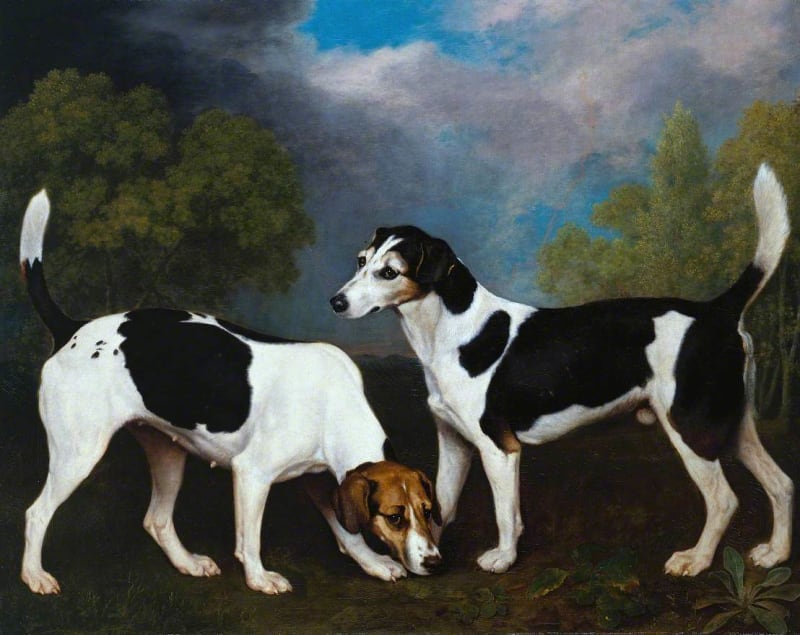
A Couple of Foxhounds (1792), in the Tate, shows two hounds against a low horizon — one standing alert, one lying with its head up. The musculature is exact; you can read the breed and the conditioning. But what stays with you is the relationship between the two animals. They are companions. The painting isn't about foxhounds in the abstract. It's about these two.
Portrait of a Large Dog (Dingo), painted in 1772, was commissioned by the naturalist Joseph Banks after his return from Captain Cook's first voyage to Australia. It is the first European painting of a dingo, and Stubbs — working from a pelt and field notes — produced an image so accurate that zoologists still cite it. The dog stands on a small rise, in three-quarter profile, against an empty sky. It is one of the great early examples of a working artist treating a non-European animal with full seriousness rather than caricature.
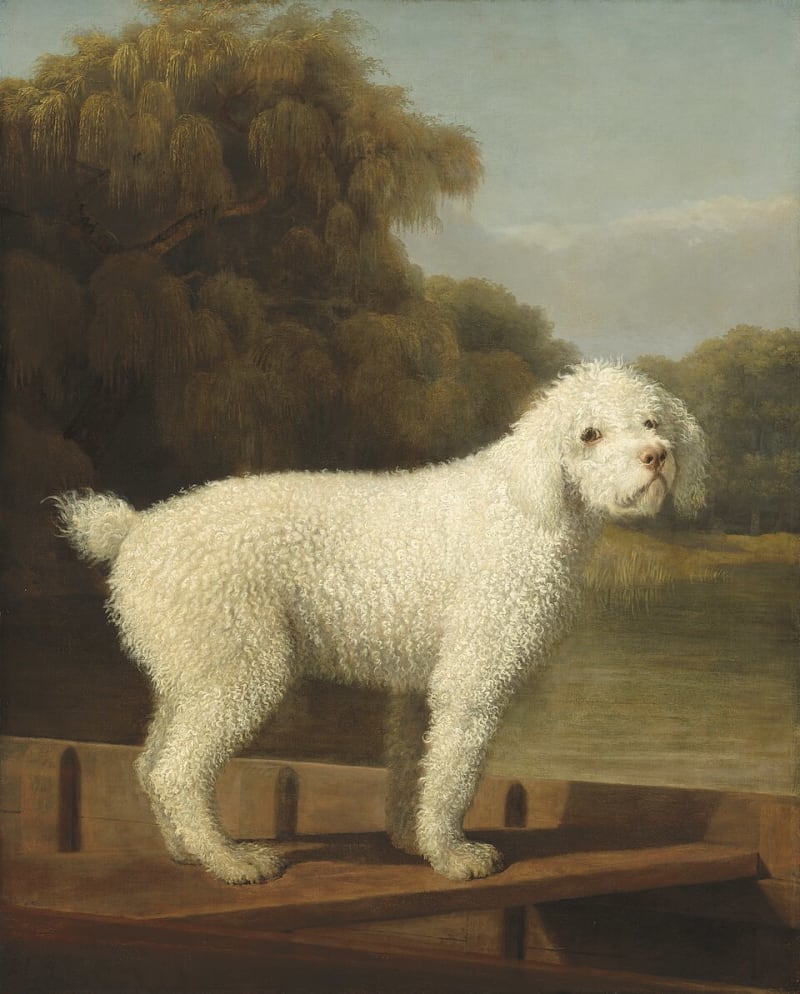
White Poodle in a Punt (c. 1780), in the National Gallery of Art in Washington, is unembarrassed about being a portrait of a pet. The dog is an individual. The setting — a small boat on still water, a low gentle sky — is observed, not invented. It is exactly the kind of painting people today mean when they say they want their dog rendered "in the old way."
What ties them together is what you don't see in lesser animal painting from the period: the sense that the painter was looking at this dog, not at the idea of a dog. Stubbs's dogs are not breed plates. They are sitters. That's the whole inheritance.
Where His Work Hangs Today
Stubbs is in the canonical museums. The Tate holds A Couple of Foxhounds, Mares and Foals in a Landscape, and the great Whistlejacket. The National Gallery in London holds several major pieces. The Yale Center for British Art in New Haven has one of the largest Stubbs collections in the world, including Portrait of a Large Dog (Dingo). The Royal Collection holds Fino and Tiny and a number of other commissions made for George IV when he was Prince of Wales. The Royal Academy, which elected him in 1780, holds drawings and anatomical studies.
His market price reflects the canonical status. Whistlejacket hangs at the National Gallery in part because the gallery acquired it from the Earl of Halifax's estate in 1997 for around eleven million pounds — at the time the highest price the National Gallery had ever paid for a single picture. Smaller studio dog portraits, when they appear at Sotheby's or Christie's, regularly hammer in the high six and low seven figures. Stubbs is no longer a sporting-art curiosity. He is a Master.
The Stubbs Tradition Today
When you walk into a country house — or, more honestly, into a Ralph Lauren ad shot in a country house — and you see a dark, beautifully framed oil painting of a spaniel above the fireplace, you are looking at the Stubbs tradition. The dignified pose. The atmospheric background. The animal rendered as a sitter, not a decoration. Three centuries on, that's still what "a proper painting of a dog" looks like in the Anglo-American imagination. Other styles come and go. This one stays on the wall.
Part of the reason is that the look does real work in a room. A vintage-style oil portrait of a dog is one of the few images you can hang in a serious room — a study, a library, a formal hallway — that is also unmistakably warm. It tells a guest two things at once: this household has taste, and this household loves its animals. Few objects do both jobs at once. A Stubbs-tradition dog portrait does.
The other reason it endures is that the underlying instinct is correct. Dogs do deserve to be painted with that level of seriousness. Anyone who has actually lived with one knows this. The painting is just catching up to a fact the household already understood.
That's the gap vintagedogoilpainting.com was built to close. Most people who love this aesthetic will never commission an oil painter at five-figure prices and wait nine months. But the look — the dignity, the dark ground, the soft light, the dog rendered as a sitter — that look is achievable now in a way it wasn't even five years ago. A modern, well-made vintage-style portrait of your own dog can hang next to a real eighteenth-century country-house piece and not embarrass itself. That's a genuinely new thing in the world.